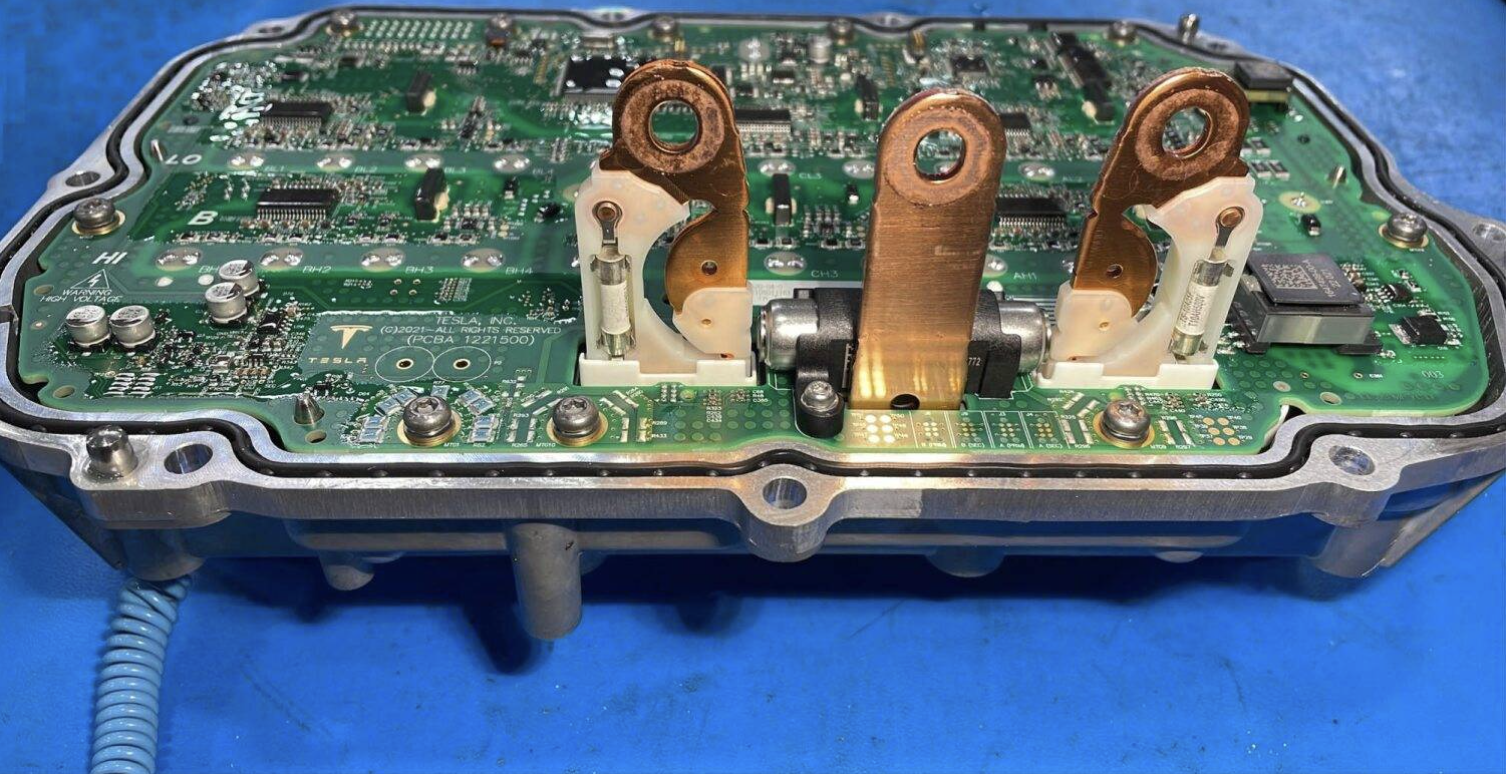
Mechanical design and validation work on drive-inverter hardware and manufacturing fixtures.

1. Overview
I interned on Tesla’s Drive Inverter Design team in Palo Alto during Summer 2026, where I designed and validated a fault-response component. Unfortunately, I cannot disclose the component itself, however, I can describe how I designed, manufactured, and validated it. My part had to function reliably through extreme vibration, thermal shock, high temperature and humidity, and salt-fog exposure. This required careful material selection, design considerations, setting manufacturing specifications, and intense validation and reliability testing to definitely prove part functionality throughout its life cycle.
2. Approach
I approached the project by breaking down the component’s requirements and identifying potential failure modes. This was done through a DFMEA (Design Failure Mode and Effects Analysis), which highlighted dozens of potential failures caused by manufacturing, assembly, and the extreme operating environments the part needed to survive. Many of these challenges included considering how different materials behaved across temperature changes, particularly how thermal expansion and stress relaxation could affect mechanical retention. Issues related to yield strength, stiffness and vibration frequencies, corrosion, plating, manufacturing and formability, and fatigue resistance were also accounted for. I used hand calculations and simulation to evaluate design choices, then compared those predictions with physical test data to guide iteration. This process required supplier coordination, fixture and testing environment setup, and coordination amongst simulation, testing, and manufacturing teams.
3. Results
My design resulted in a 500-unit T0 build of the fault-response component. All parts tested during initial validation met the relevant strength, electrical resistance, and functionality criteria. Investigated, and defined optimal manufacturing practices and specs for part production. I also developed a reliability-test plan to evaluate the component’s robustness throughout its life cycle.
Alongside this project, I designed, fabricated, and tested three fixtures supporting PCBA calibration, sensor mounting and calibration, and laser-welding operations. Using CAD, 3D printing, machining, and materials available in Tesla’s labs, I delivered these fixtures on short timelines to support the team’s testing and manufacturing work.
Skills & Tools
More Photos